
Freight alone does not show your total logistics cost
A quote with cheap port-to-port freight can turn expensive through demurrage, storage, handling and transshipment. How to compare quotes door to door and line by line.
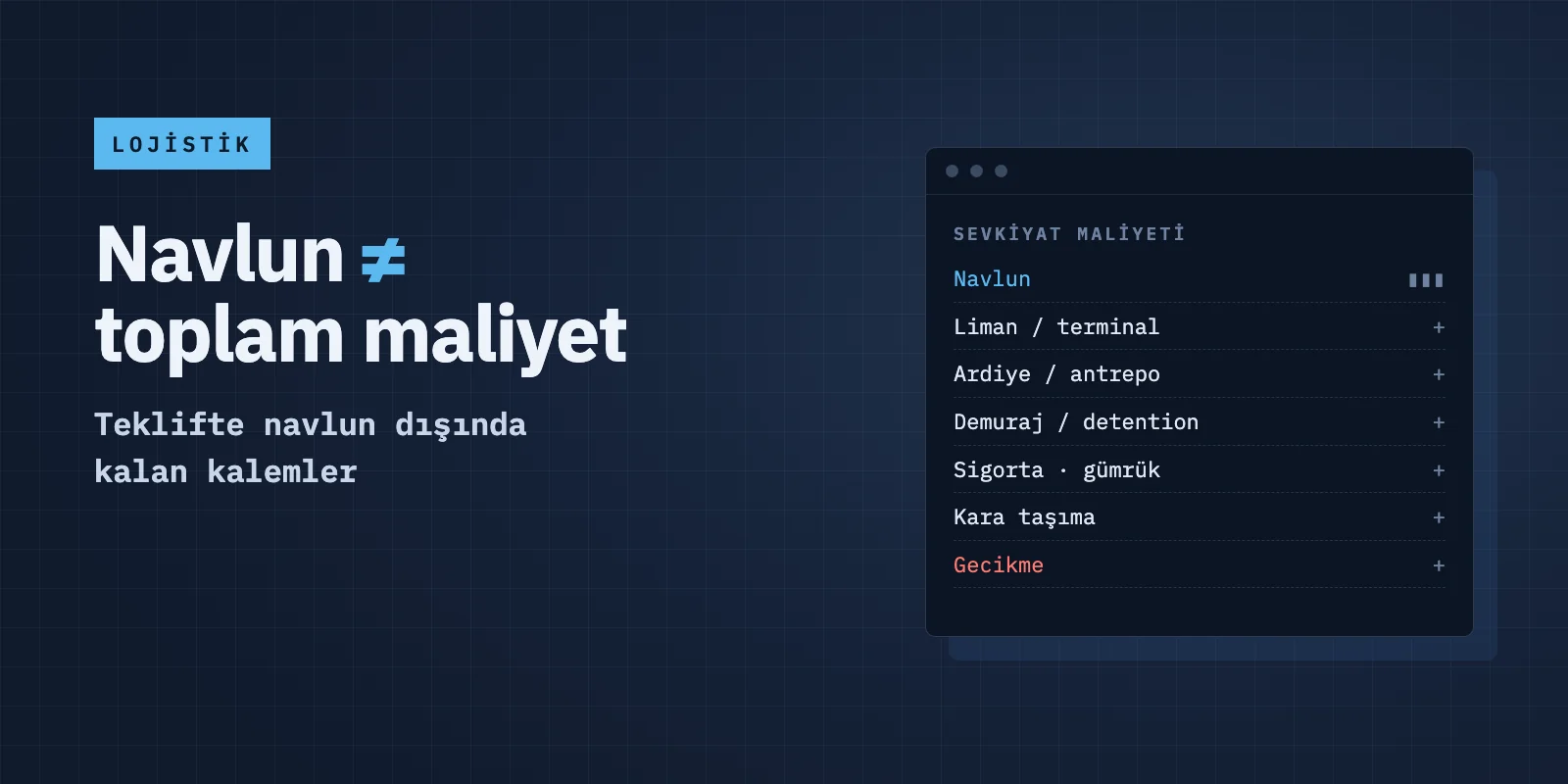
Freight is one line on a shipment's invoice. In a 15 October 2026 article in the Turkish newspaper Ticaret Gazetesi, Ali Demircan of Lanes Lojistik makes this point about global trade: even if freight eases on some lanes, total logistics cost may not fall by the same share. An exporter who picks a quote by the freight line sees the gap on the invoice. A forwarder who quotes the customer a single price sees it in the margin.
What Demircan says
According to the article, his starting point is that growing trade volume does not bring low freight on every lane. One lane can have surplus capacity while another is short of space or empty containers. Longer routes mean ships complete fewer voyages in the same period, which cuts effective capacity. Alternative ports can add trucking, handling or transshipment costs.
In his view, a quote with cheap port-to-port freight can turn expensive once waiting and road costs are added. He recommends comparing quotes on the same scope, with free time, surcharges, delivery point and empty container return defined the same way in each. He adds that uncertain transit times raise the need for working capital and safety stock.
The article cites a WTO (World Trade Organization) forecast of 8 October 2026 expecting world merchandise trade volume to grow 3.9% in 2026 and 4.1% in 2027. It gives no freight rates or cost percentages, and the views come from a forwarder's perspective.
A related Ticaret Gazetesi article dated 9 October looks at Gulf shipments. Risks around the Strait of Hormuz have put alternative ports and sea-plus-road combinations on the table for them. The advice there is the same: compare options door to door, not port to port. Demircan is quoted (in Turkish) as saying that drawing a route on a map does not mean the route is operationally ready.
The other lines on the invoice
Besides freight, the total cost of a shipment usually includes:
- Port and terminal charges (handling, THC, terminal gate fees)
- Bonded warehouse and storage fees
- Demurrage and detention (container and equipment waiting charges)
- Insurance
- Customs clearance, declarations and related costs
- Currency effect (the gap between quote and invoice currencies)
- Fuel and other surcharges
- Road haulage and transshipment
- The indirect cost of delay: tied-up capital, extra stock, production disruption, risk of losing customers
Most of these do not show at the quote stage; they appear during the operation. Demurrage and detention are a good example. Free time takes up a few words in the quote, but when paperwork is incomplete or the consignee is slow to collect, the charge runs day by day while the container waits at the port or at the customer. If the cargo sits at the port uncollected, storage is added on top.
Handling grows when the route changes. Each extra discharge and reload at an alternative port or transshipment hub brings its own fee and its own damage risk. Insurance follows that risk, since route, number of transshipments and cargo type all affect the premium. Some quotes leave insurance out entirely, and it is bought separately later.
Surcharges, waiting time or alternative port costs that follow a cheap port-to-port quote can wipe out the saving quickly. Before deciding, ask whether each item is in the quote and who it will be billed to.
Why a freight cut does not reach the total
Route changes lengthen voyages and reduce effective capacity. Capacity imbalance leaves ships and equipment plentiful on some lanes and scarce on others. Transit time uncertainty comes back onto the invoice under other headings: waiting charges, extra stock and financing costs. A drop in freight can be partly or fully offset by increases in these items, and anyone watching only the freight line will miss it.
For forwarders: which line is eating the margin
For a forwarder the problem runs the other way. If the customer gets a single all-in price and costs are tracked as one total, there is no way to see which line is eroding the margin. When freight eases, the customer expects a discount. If terminal, demurrage or surcharge lines rose in the same period, the real margin left after that discount is unclear. We covered the case for keeping revenue and cost lines separate in a quote here: https://boransoftware.com/en/blog/forwarder-teklifi-gelir-maliyet-kalemleri/
What to do in quoting and operations
- Compare quotes on the same scope: free time, surcharges, delivery point and empty container return terms in writing.
- Judge freight as part of the door-to-door total, not on its own.
- Finish paperwork and consignee preparation before shipment; avoidable waiting generates demurrage and storage.
- Consolidate suitable loads and set a regular loading schedule.
- Compare sea, road, air and combined options for each shipment. Sending the urgent part by air and the rest by sea can be an option.
- Count the cost of delay together with the transport price.
- Compare quoted and actual cost line by line, and update the line that drifted in the next quotes.
Doing the last step routinely depends on keeping quotes and actual costs in one place, on separate lines. ECELA keeps quote, revenue and cost items as separate lines. When a shipment closes, quoted and actual figures are compared line by line, showing how much of a freight movement actually reached the margin: https://boransoftware.com/en/urunler/ecela/
Sources
- Ticaret Gazetesi (15 October 2026): https://ticaretgazetesi.com.tr/2026/10/15/kuresel-ticaret-buyuyor-lojistik-maliyetleri-neden-gerilemiyor/
- Ticaret Gazetesi (9 October 2026): https://ticaretgazetesi.com.tr/2026/10/09/hurmuz-bogazi-sonrasi-korfez-lojistiginde-yeni-rotalar/