
e-TIR: Türkiye-Azerbaijan pilot to start at Dilucu-Sederek
The first Türkiye-Azerbaijan e-TIR pilot is due to start at Dilucu-Sederek before the end of 2026. How e-TIR works, plus a checklist for hauliers, forwarders and brokers.
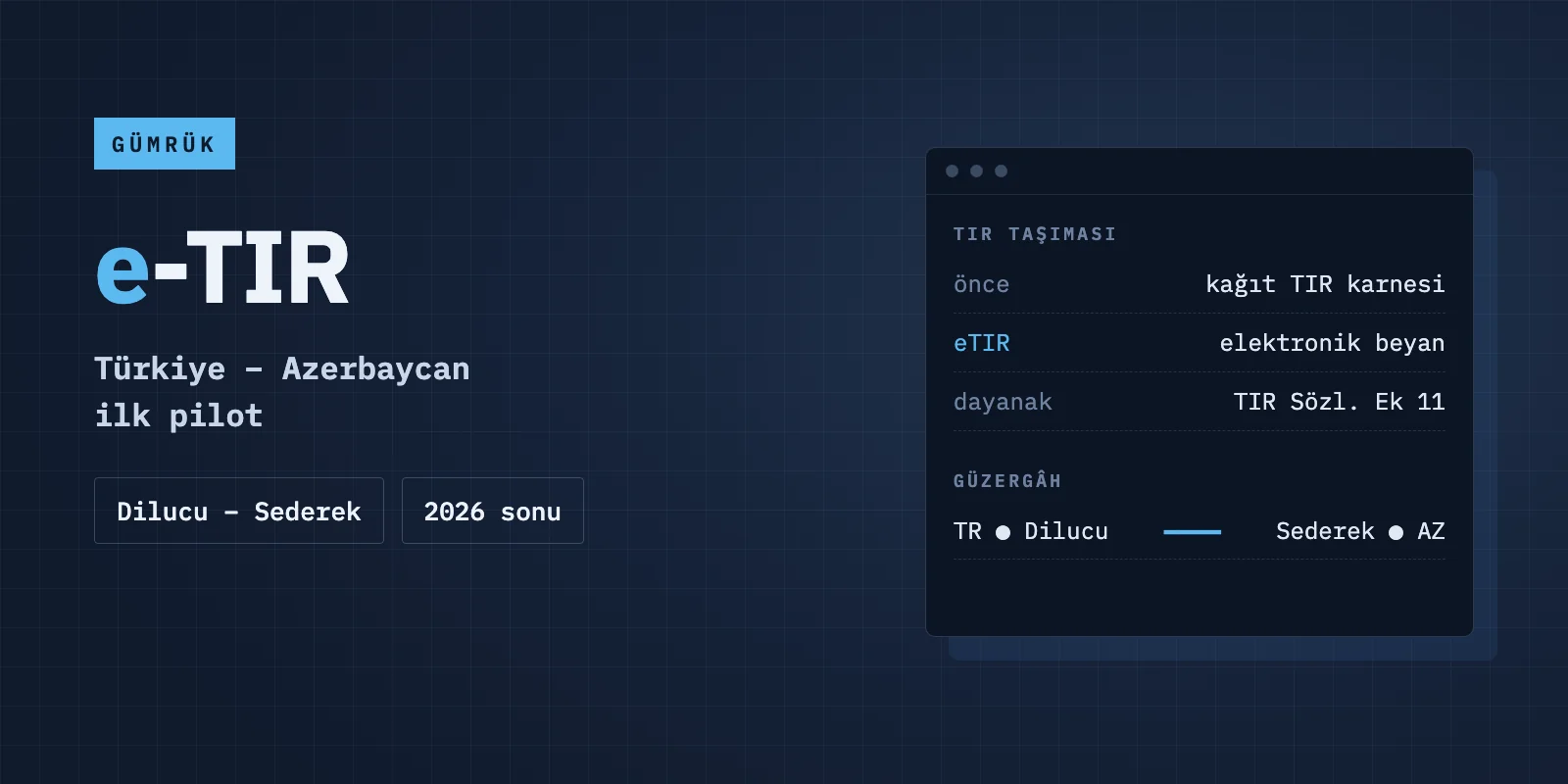
Türkiye and Azerbaijan are due to start their first e-TIR pilot at the Dilucu-Sederek border crossing before the end of 2026, according to an official statement. It is the first time Türkiye's move from the paper TIR carnet to electronic data exchange has been tied to a specific crossing and a timeframe. Hauliers, forwarders and customs brokers working the Azerbaijan route can start preparing now.
What was announced
Customs chiefs from the member states of the Organization of Turkic States (OTS, in Turkish TDT) held their 12th meeting in Bishkek on 12 October 2026. Türkiye was represented by a Ministry of Trade delegation led by Deputy Minister of Trade Sezai Uçarmak. According to Alomaliye, Uçarmak said Türkiye is leading on the e-TIR system and that the first pilot with Azerbaijan would begin at the Dilucu-Sederek customs gates before the end of 2026.
The exact start date and scope (which hauliers, which goods) have not been made public and we found no separate Ministry announcement, so the date rests on an official's statement and may change.
How e-TIR works
TIR is an international transit regime: goods travel from one customs office to another in a sealed load compartment, with no new declaration in each transit country. The paper TIR carnet is both the transit declaration and the guarantee for duties and taxes. e-TIR runs the same procedure without paper. Transport and guarantee data move electronically, in near real time, between the haulier, the customs administrations and the guarantee chain. Because customs receive the declaration before the truck reaches the border, they can run their risk analysis in advance.
The legal basis is Annex 11 to the TIR Convention. According to the UNECE page of the Turkish Ministry of Trade, Annex 11 entered into force for the Contracting Parties on 25 May 2021 and allows TIR operations to be carried out paperlessly instead of with a paper carnet. It applies only between parties bound by it, so both countries must have connected their systems and be ready. Pilots test that readiness with real traffic.
What a pilot means
A pilot tries the system at a single crossing, on a limited number of shipments, under real conditions. It is not a general switch-over. Participation terms have not been announced. We expect hauliers on paper carnets to carry on as before during the pilot, and joining e-TIR to be voluntary and to need some groundwork.
eTIR is already running elsewhere in the region. According to IRU, as reported by Trend, it operates on several corridors linking Azerbaijan, Kyrgyzstan, Tajikistan, Turkmenistan and Uzbekistan. Türkiye is preparing to launch on the Türkiye-Azerbaijan route, and Kazakhstan on the Kazakhstan-Uzbekistan route. At the same meeting IRU proposed extending the "green lane" for e-TIR operations, and the need to train customs and transport operators on digital systems was raised.
Practical effects for hauliers, forwarders and brokers
This section is our own assessment, drawn from industry experience rather than from the sources.
- Data reaches customs before the load reaches the border. Goods description, gross weight, consignor and consignee, plate and seal details have to be right and consistent from the start; correcting them later costs more than it does on paper.
- If the commercial invoice, packing list, transit declaration and e-TIR data for one shipment show different figures, the mismatch is caught automatically. The data needs to come from one source.
- Firms joining the pilot should first check whether their forwarding and brokerage software can exchange data with the guarantee chain and customs without manual re-keying.
- Paper carnets get lost or forged. In an electronic process the status can be queried, which makes it easier to tell customers where a shipment is.
- As IRU stressed, drivers, operations staff and brokerage teams will need time to get used to the new process.
Preparation checklist
- List which of your routes involve Azerbaijan transit and pick out customers suited to the pilot.
- Confirm your TIR carnet holder status and your relationship with the relevant body in the guarantee chain.
- Review shipment data quality: HS code (GTİP in Türkiye), goods descriptions, weights, party details.
- Check whether your systems can produce customs declaration data in a structured format.
- Follow announcements on pilot participation from the Ministry of Trade and the relevant associations, and wait for the official channel for applications and scope.
- Decide how you will keep a paper carnet fallback during the pilot and what instructions drivers will get.
ECELA
Boran Software develops ECELA for forwarding, customs and bonded warehouse operations. In our experience, most of the work in paperless transit is keeping shipment data clean and reusable. No technical interface requirement for e-TIR has been published yet, so we are not announcing a pilot-specific ECELA feature; we will update this post as details become clear. Product page: https://boransoftware.com/en/urunler/ecela/
Sources
- Alomaliye, Customs cooperation and the e-TIR agenda at the OTS: https://www.alomaliye.com/2026/10/13/tdtde-gumruk-isbirligi-ve-e-tir-gundemi/
- IRU (published by Trend), OTS member states support expansion of the digital TIR system: https://www.trend.az/business/4237491.html
- Turkish Ministry of Trade, UNECE page (Annex 11 and eTIR): https://trade.gov.tr/multinational-relations/united-nations-economic-commission-for-europe-unece