
Paper invoices end in 2027: e-Arşiv becomes mandatory for simplified-procedure and business-account taxpayers
From 1 January 2027, simplified-procedure and business-account taxpayers in Türkiye must issue every invoice electronically, whatever the amount. Dates, options and a two-month checklist.
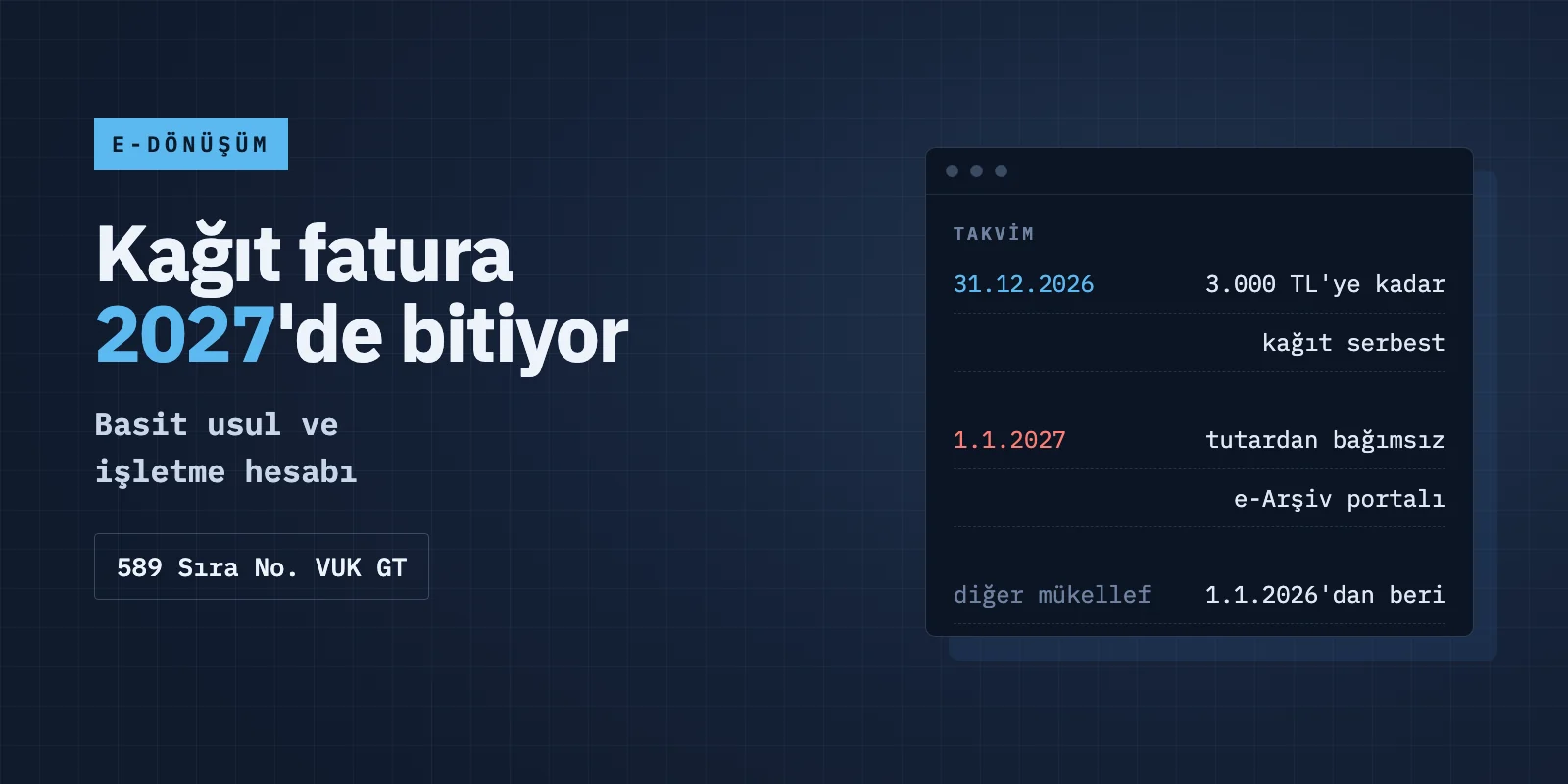
From 1 January 2027, tradespeople taxed under Türkiye's simplified procedure (basit usul) and taxpayers keeping books on the business account basis (işletme hesabı) can no longer issue paper invoices, even if they are not registered for e-Fatura or e-Arşiv. Every invoice, whatever the amount, will have to be issued through the e-Belge (e-Arşiv) Portal of GİB (Turkish Revenue Administration) or through a licensed private integrator. A regulation dated 31 December 2025 had pushed this deadline back by a year, and the new year is two months away.
Legal basis: VUK General Communiqué No. 589
The rule is set out in General Communiqué No. 589 on the Tax Procedure Law (VUK, Vergi Usul Kanunu), published in the Official Gazette (Resmî Gazete) dated 31/12/2025, issue 33124 (5th repeated issue). It amended section IV.2.4.3 of VUK General Communiqué No. 509, "Other invoices required to be issued as e-Arşiv invoices". The extension applies only to taxpayers whose commercial profit is determined under the simplified procedure and to those keeping books on the business account basis; dates for everyone else stayed the same.
The 02.01.2026 date at the top of the TÜRMOB (Union of Chambers of Certified Public Accountants of Türkiye) page is the date of its announcement. The communiqué itself was published on 31/12/2025.
Who is affected
The rule covers taxpayers not enrolled in e-Fatura or e-Arşiv Fatura. They fall into two groups:
- Simplified-procedure and business-account taxpayers: the deadline moved back by one year.
- All other taxpayers: no change; the requirement became independent of the amount on 1/1/2026.
Taxpayers already registered for e-Fatura or e-Arşiv have always had to issue e-Fatura or e-Arşiv invoices, and the change adds no new obligation for them.
Dates
Simplified-procedure and business-account taxpayers:
- 1/1/2025 to 31/12/2026: invoices with a total of up to TRY 3,000 including taxes may be issued on paper; invoices above TRY 3,000 go through the GİB e-Arşiv portal.
- From 1/1/2027: every invoice, whatever the amount, is issued as e-Arşiv. Invoice forms obtained from the tradesmen's chamber (esnaf odası) can no longer be used.
Other taxpayers:
- 1/1/2025 to 31/12/2025: invoices above TRY 3,000 were e-Arşiv; smaller ones could be on paper.
- From 1/1/2026: every invoice, whatever the amount, is e-Arşiv.
A simplified-procedure taxpayer can use paper in 2026 only for invoices up to TRY 3,000. Any invoice above that threshold already has to go through the portal.
What stays the same
The rule concerns the "invoice" document. Sales that do not require an invoice and can be documented with a retail sales receipt or a cash register (ÖKC) receipt can continue with those documents. The exceptions in sections V.7 and VIII of the communiqué also still apply. We have not covered them here; check those sections or ask your accountant about your own case.
Non-compliance triggers the penalty under Article 353 of the Tax Procedure Law. According to the communiqué, the penalty applies separately to each paper invoice issued to, or received from, a buyer who is a taxpayer rather than a final consumer, and it covers both the issuer and the buyer. If seller and buyer are both e-Fatura users, every invoice between them must be an e-Fatura.
Portal or private integrator
The communiqué recognises both routes: the e-Belge issuing portal provided by GİB, or the systems of private integrators that have built the required integration and hold permission from the Administration. The comparison below is our own assessment and is not part of the communiqué.
- The portal costs nothing extra, but every invoice is keyed in by hand. That is enough for a taxpayer issuing a few invoices a month.
- A private integrator charges a fee. In return, invoices can be sent automatically from your bookkeeping or stock software. As volume grows, the errors and time lost to manual entry start to weigh more.
When choosing, look at three things: how many invoices you issue a month, whether you invoice the same customers repeatedly, and whether your current accounting program can be connected.
What to do in the next two months
- Have your accountant confirm your tax status: simplified procedure, business account or standard procedure (gerçek usul).
- Pull the number and value distribution of your invoices for September and October to see how much you rely on paper invoices under TRY 3,000.
- Choose between the portal and an integrator. If you go with an integrator, confirm it is a licensed provider.
- Test your GİB e-Belge portal account and user permissions now rather than in the year-end rush.
- Get customer and product or service data ready: company name, tax number, item names, VAT rates.
- Decide what to do with leftover paper invoice pads and tradesmen's chamber invoice forms; they cannot be used in 2027.
- Settle how invoices will flow into your accounting records, and archive portal output regularly.
- Give staff who issue invoices, and office personnel, short written instructions.
The e-Defter link
Once invoices move to e-Arşiv, the next step is getting them into the accounting and ledger flow consistently. Boran Software's e-defter (electronic ledger) integration covers that flow. Details: https://boransoftware.com/en/blog/e-defter-entegrasyonu/
Sources
- Muhasebetr, Legislation: https://www.muhasebetr.com/guncelmevzuat/mevzuat_oku.php?mevzuat_id=7116
- TÜRMOB, Obligation for taxpayers outside e-Fatura/e-Arşiv to issue e-Arşiv invoices via the GİB portal (announcement, 02.01.2026): https://www.turmob.org.tr/ekutuphane/Read/9208c1d3-f311-468d-9dd7-0d50a202bd6c
- Official Gazette, 31.12.2025 5th repeated issue (General Communiqué No. 589; PDF): https://www.resmigazete.gov.tr/eskiler/2025/12/20251231M5-32.pdf